Scientific laboratory equipment

Technical Insights: Design of Experiments in Immunoassay Development

Practical guidance on experimental design, optimization strategies, and common pitfalls in immunoassay development.

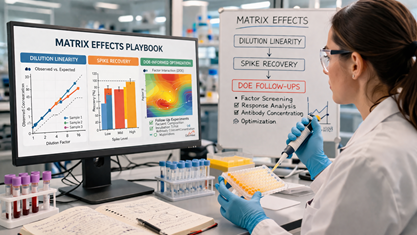
Matrix Effects Decoded: A Practical Playbook for Dilution Linearity, Spike Recovery, and DOE-Driven Optimization
Assay Robustness
4/6/2026Dr. Reuben O

Matrix Effects Decoded: A Practical Playbook for Dilution Linearity, Spike Recovery, and DOE-Driven Optimization

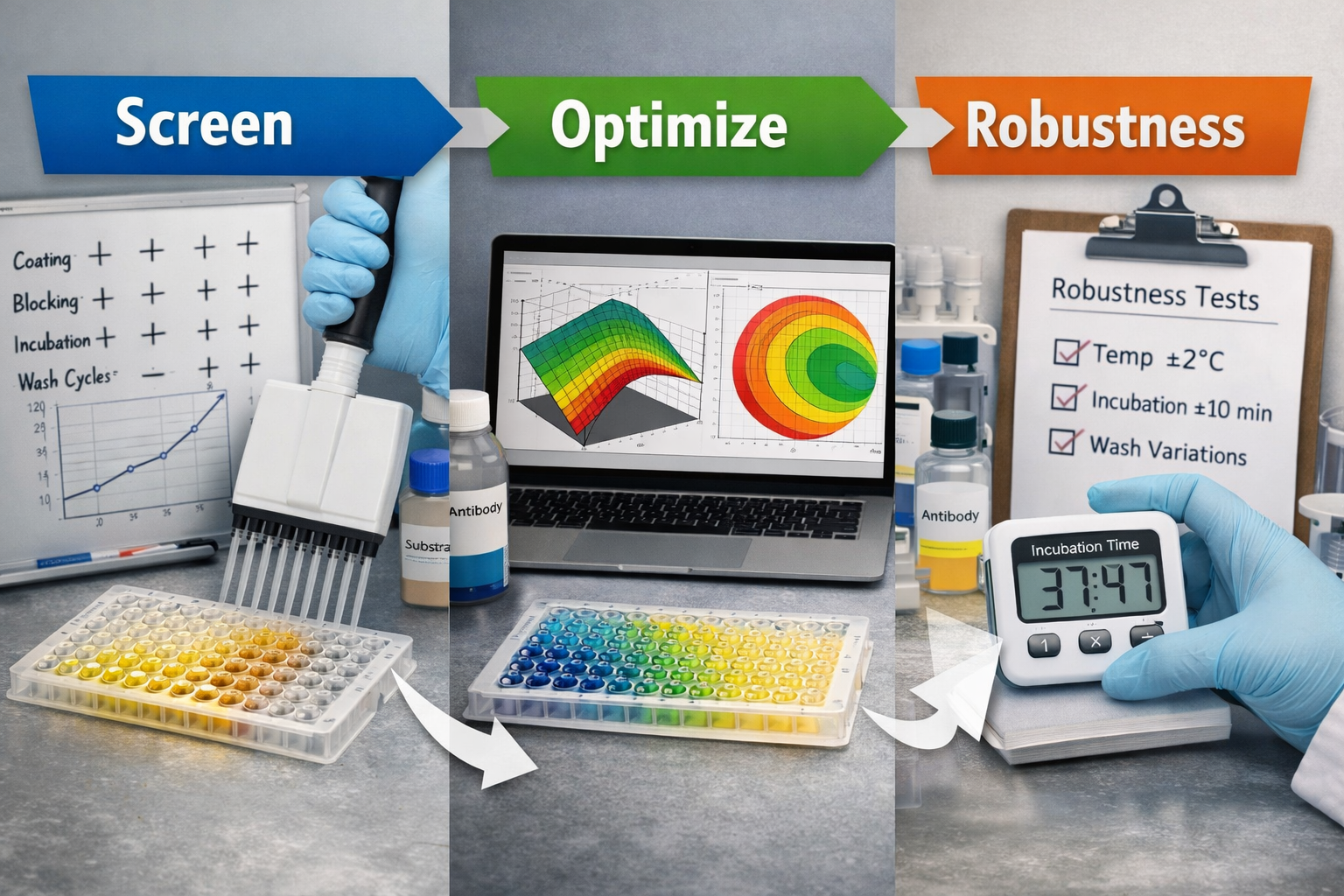
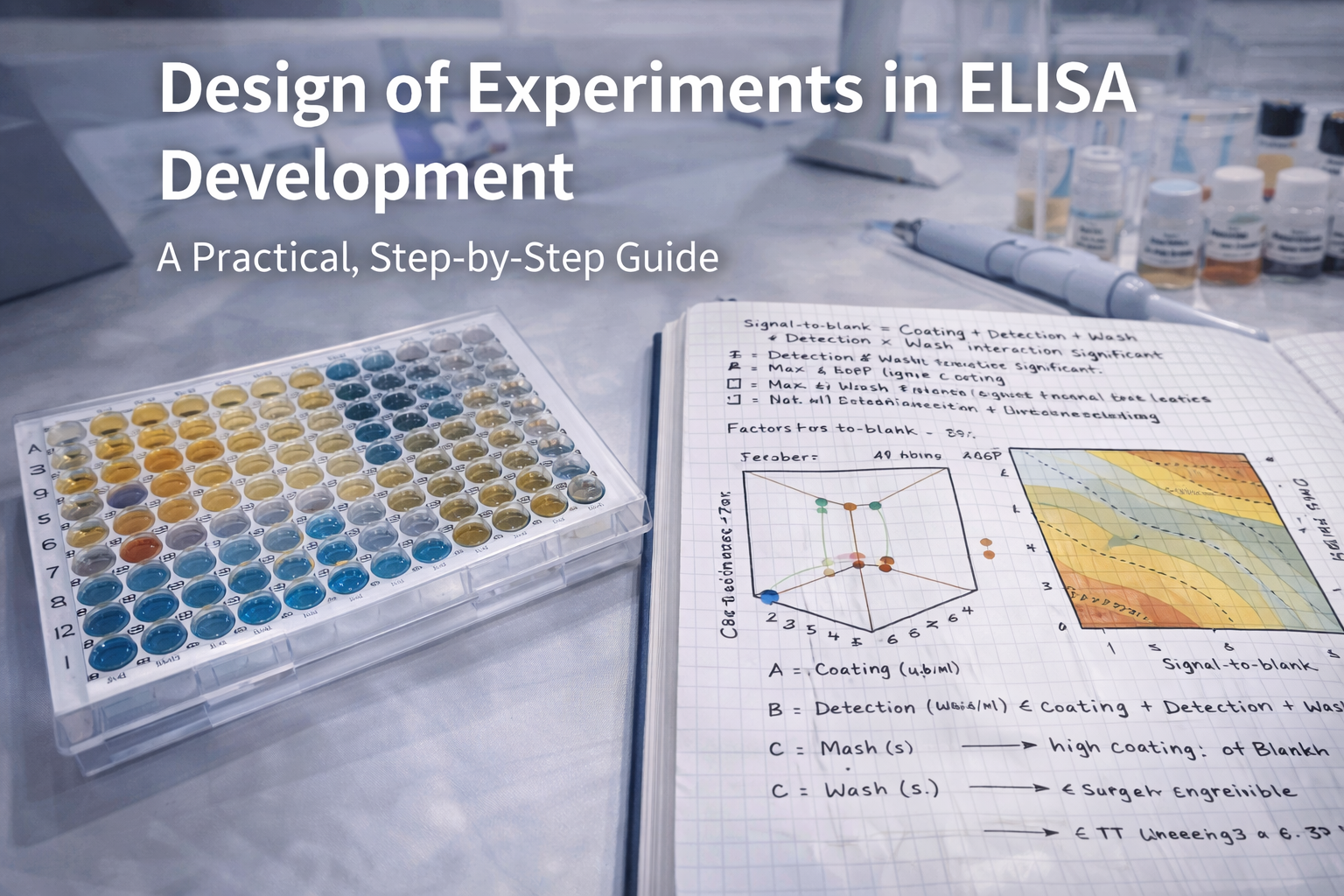
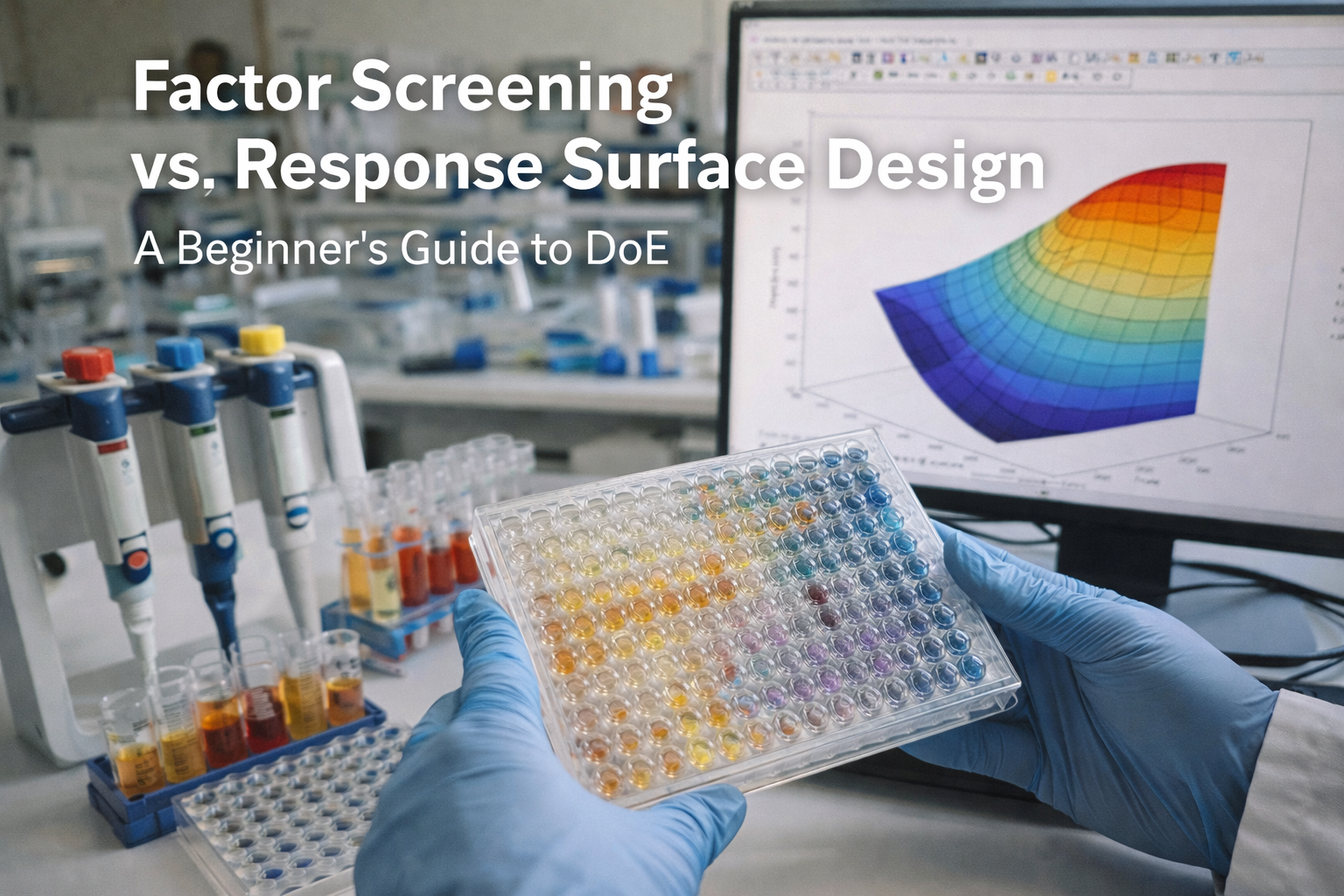
Matrix effects aren't edge cases — they're the rule. Every immunoassay developer has encountered unexpected bias, nonlinear dilution responses, or inconsistent spike recoveries that defy a carefully optimized calibration curve. The instinct is to troubleshoot. The better move is to build a system. Dilution linearity and spike recovery are the starting point, not the finish line. They tell you a problem exists — not why it exists, and not how to fix it efficiently. That's where design of experiments changes everything: instead of changing one variable at a time and hoping for the best, DOE lets you investigate multiple factors at once, quantify their interactions, and find optimal conditions in a fraction of the runs. This guide walks through the full framework — from first diagnostic to optimized assay.

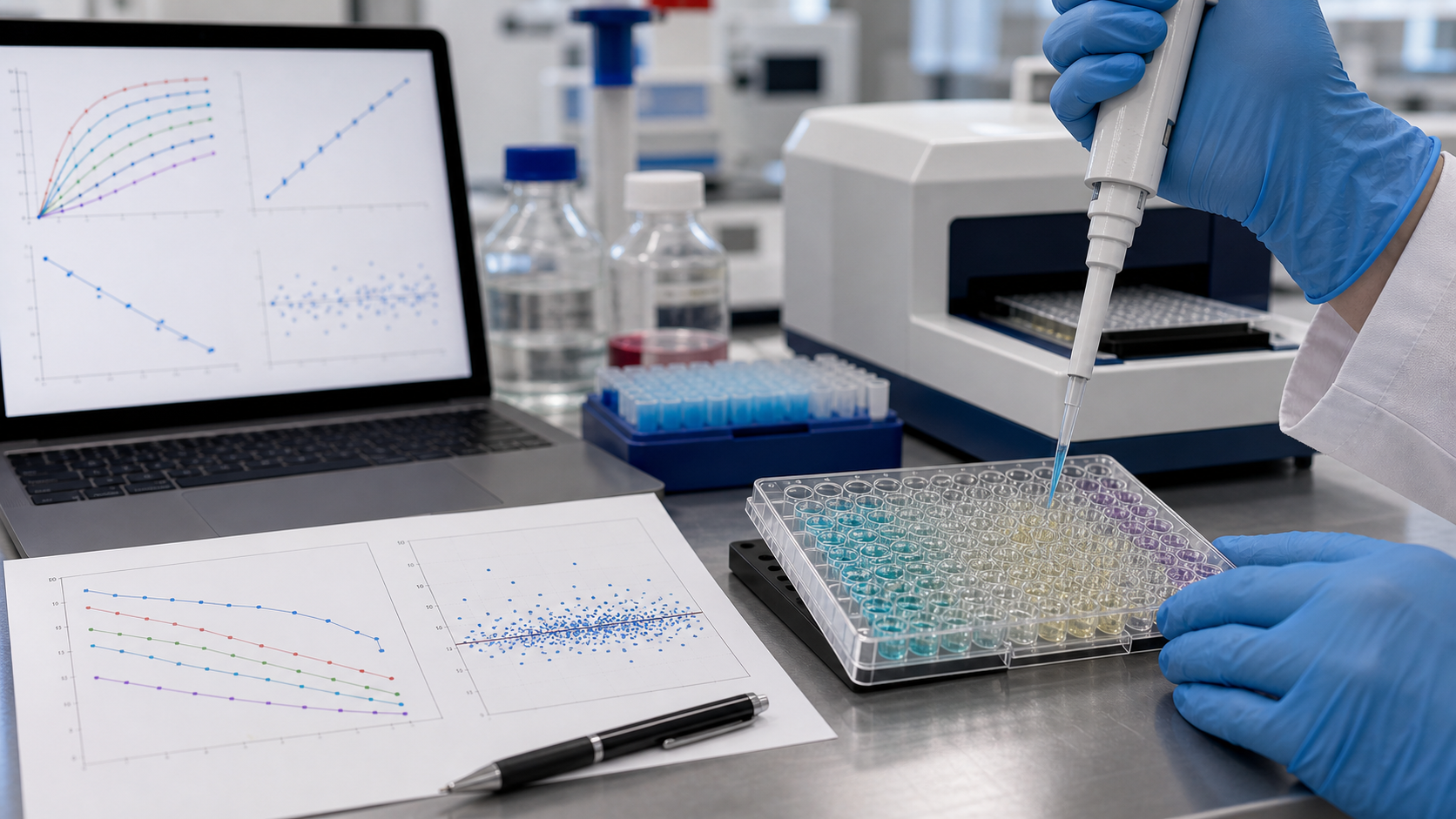
Precision (%CV) problems: designing experiments to isolate pipetting vs biology vs reagent drift
Assay Robustness
4/2/2026Dr. Reuben O

Precision (%CV) problems: designing experiments to isolate pipetting vs biology vs reagent drift

Achieving a CV below 10% requires moving beyond aggregate data. This guide to Precision %CV Troubleshooting provides a systematic engineering framework to partition the error budget of your immunoassay. By utilizing Design of Experiments (DOE) and signature analysis, developers can mathematically isolate whether high variance stems from mechanical pipetting physics, stochastic biological noise, or systemic reagent drift across the plate. Stop guessing and start engineering a more robust, validated assay.

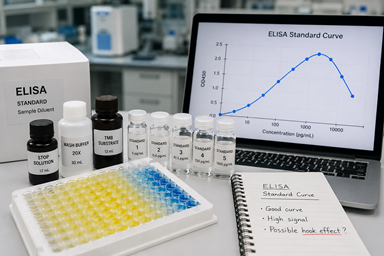
Low Sensitivity in Immunoassays: The 5 Key Factors That Control ELISA Detection Limits
DOE Fundamentals
3/13/2026Dr. Reuben O

Low Sensitivity in Immunoassays: The 5 Key Factors That Control ELISA Detection Limits

Low sensitivity in immunoassays often results from inefficiencies across the signal chain rather than a single parameter failure. This article examines the five experimental “knobs” that most strongly influence assay sensitivity—capture antibody density, detection chemistry, incubation conditions, sample matrix effects, and wash stringency—and explains how a practical DOE approach can identify which factors truly limit signal in ELISA and other plate-based immunoassays.

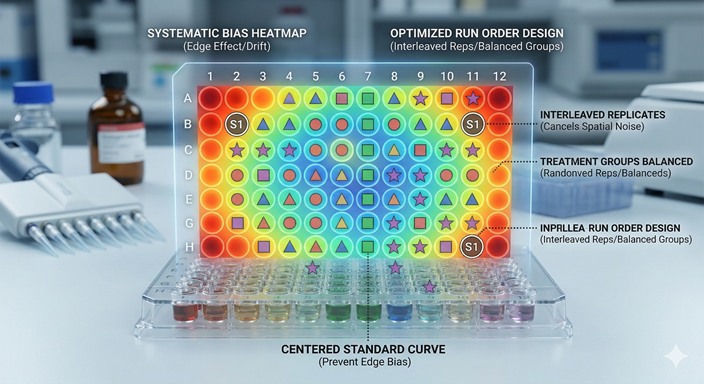
Plate Effects, Timing Drift, and Batching: How I Design Run Order in Immunoassays
Assay Robustness
3/2/2026Dr. Reuben O

Plate Effects, Timing Drift, and Batching: How I Design Run Order in Immunoassays

Stop losing your biological signal to technical noise. In this deep dive, I reveal how I design run order in immunoassays to neutralize the 'invisible' variables that plague development: plate effects, timing drift, and batching. Move beyond simple randomization and learn how a DOE-based approach to plate geography and timing can transform your CVs and build unparalleled credibility for your results.

Want More DOE Insights?

We regularly publish new articles on experimental design strategies, optimization techniques, and practical guidance for assay developers.